User Experience work
Steam platform redesign
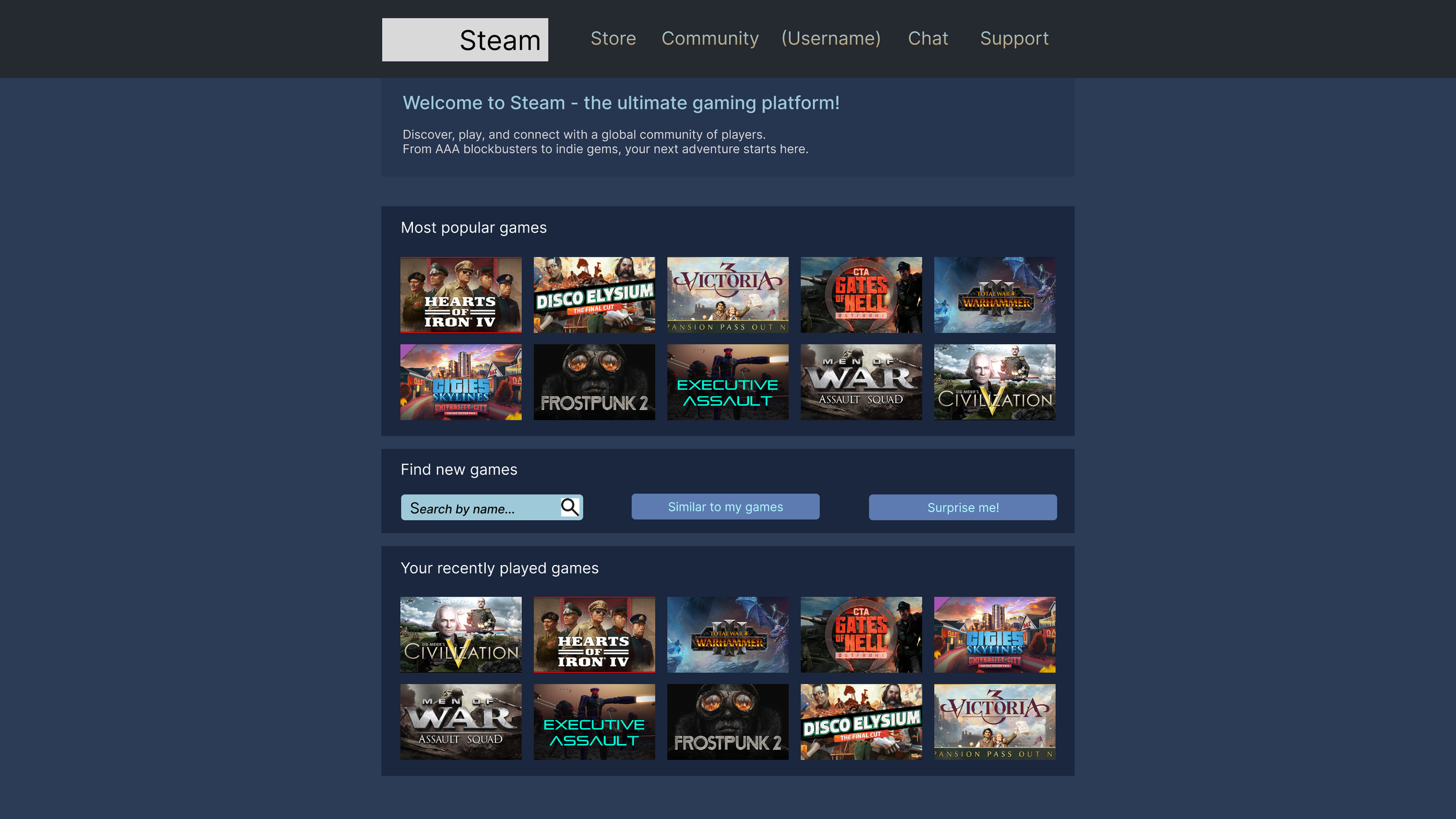
The objective of this UX redesign was to critically evaluate and improve the Steam web app experience through a more structured, readable, and user-centred interface. The project focused on reducing visual clutter, improving content discoverability, and resolving usability issues across the Store, Community, Workshop, and Support sections of the platform. Don Norman’s design principles were used as the primary evaluative framework, with particular attention given to visibility, feedback, affordance, mapping, constraints, and consistency.
The prototype was developed through a staged UX process involving case study analysis, persona development, wireframing, peer evaluation, cognitive walkthroughs, heuristic analysis, affinity mapping, and iterative prototype refinement. The redesign aimed to preserve Steam’s established visual identity while improving navigation clarity, interaction feedback, support pathways, and community engagement. Additional gamification systems, including quests, badges, progress indicators, and contribution rewards, were proposed to strengthen user motivation and make platform interaction more engaging without increasing interface complexity.
Key Achievements
Redesigned a Content-Dense Digital Platform to reduce visual clutter, improve readability, and create a more focused Steam web app experience across store, community, workshop, and support pathways.
Applied Don Norman’s UX Principles: Used visibility, feedback, affordance, mapping, constraints, and consistency as a structured framework to identify usability weaknesses and guide practical redesign decisions.
Improved Navigation Architecture by refining user pathways for purchasing featured games, finding game mods, locating discussion forums, and accessing support for refund-related issues.
Reduced Cognitive Load: Reorganised high-volume platform content through clearer visual hierarchy, grouped interface elements, improved spacing, and more predictable page structures.
Strengthened Interaction Feedback: Proposed hover states, opacity changes, confirmation messages, progress indicators, and clearer button responses to reduce user uncertainty during key interactions.
Enhanced Workshop and Community Usability: Addressed unclear affordances around mod subscription, community discussion access, rating systems, and game-specific navigation through clearer labels, tooltips, and visual cues.
Conducted Peer Evaluation and Iterative Refinement: Analysed feedback from three peer reviewers to identify issues with icon sizing, inconsistent spacing, limited interactivity, false affordances, and unclear navigation outcomes.
Performed Cognitive Walkthrough Testing: Evaluated critical user tasks including buying a featured product, subscribing to a game mod, reading game forums, and requesting support for a recently purchased game.
Completed Heuristic UX Analysis: Assessed the prototype against Jakob Nielsen’s usability heuristics to identify issues in error prevention, user control, recognition rather than recall, minimalist design, and help documentation.
Synthesised Findings through Affinity Mapping: Organised peer feedback, walkthrough results, and heuristic findings into key usability themes including visibility, feedback, affordance, mapping, constraints, consistency, and testing insights.
Integrated Gamification Systems: Proposed daily quests, badges, points, leaderboards, progress bars, and reward feedback to improve community participation, support engagement, and content discovery.
Preserved Steam’s Platform Identity: Balanced usability improvements with Steam’s existing dark visual language, blue accent palette, and familiar platform conventions to ensure the redesign remained recognisable to existing users.